Total Chaupais
40
 Devpur
 Chalisa of Goddess Durga
Durga Chalisa is a 40-verse devotional hymn to Maa Durga, used for courage, protection, and steady Shakti-focused worship.
Reviewed by Devpur Editorial Team on 31 March 2026
Total Chaupais
40
Language
English
PDF Support
Not available
नमो नमो दुर्गे सुख करनी।
नमो नमो अम्बे दुःख हरनी॥

नमो नमो जग जननी भवानी।
तुम ही हो सुख की खानि॥
Namo Namo Durge Sukh Karni.
Namo Namo Ambe Dukh Harni.

Namo Namo Jag Janani Bhavani.
Tum Hi Ho Sukh Ki Khaani.
Durga Chalisa praises Maa Durga as the source of protection, courage, and compassionate guidance, and it is commonly used for steady daily worship.
Durga Chalisa is a forty-verse devotional hymn in praise of Maa Durga. It is one of the most practical ways devotees connect with Shakti in daily life because it combines rhythm, reverence, and a clear spiritual focus. The opening lines, such as “Namo Namo Durge Sukh Karni” and “Namo Namo Ambe Dukh Harni,” immediately frame Durga as both compassionate and protective.
Unlike a long theological text, the Chalisa is made for prayer. It can be recited at home, in a temple, or during Navratri as part of a simple but meaningful worship routine. Many families use it because it is short enough to sustain and deep enough to feel substantial.
Devotees turn to Durga Chalisa for several reasons.
The hymn works especially well for people who want a prayer that is repeatable. A mantra may feel very short, while a larger scripture may feel too heavy for a routine. Durga Chalisa sits in the middle: it is accessible, devotional, and rich enough for reflection.
The Chalisa does more than praise Durga. It teaches a way of approaching life. The opening and middle verses consistently remind the devotee that strength should stay connected to humility. Protection should stay connected to compassion. Devotion should stay connected to action.
That matters because many readers come to the Chalisa at moments of uncertainty. The hymn answers that need by giving a stable devotional rhythm. It does not ask the devotee to solve everything instantly. It asks the devotee to keep returning to Durga with trust, clarity, and sincerity.
If you are reading the meaning for the first time, do not try to decode every line in one sitting. Focus on the recurring themes:
Once these ideas are clear, the rest of the hymn becomes easier to follow. That makes the Chalisa more than a memorized text. It becomes a personal devotional guide.
The Chalisa becomes more useful when the devotee does not rush through it. A balanced method is:
This helps the text become more than memory work. Even if you do not know every verse by heart, the prayer still becomes meaningful when you understand the core message: Durga removes fear, gives strength, and protects the devotee’s inner balance.
Durga Chalisa is especially important during Navratri because the festival centers on Durga’s forms, power, and disciplined worship. In many homes, the Chalisa becomes part of the evening routine along with diya, flowers, mantra, and aarti.
A simple Navratri sequence can look like this:
That sequence is simple, but it creates continuity. This is often more useful than trying to perform a complicated ritual only once.
For home worship, the most important thing is consistency. A devotee may recite the Chalisa:
If pronunciation is difficult, begin with a slower reading and then build confidence. The point is not performance. The point is steady relationship with Maa Durga through repeated prayer.
Durga Chalisa is simple, but a few mistakes can weaken the experience.
The most useful habit is small and repeatable. If you can recite even one section with focus every day, the practice is already meaningful.
This page is most helpful when used alongside the rest of the Durga cluster.
Those pages answer the next questions a reader usually has after learning what the Chalisa is. A good devotional page should reduce confusion, not create more of it.
Durga Chalisa works well for families because it can be shared. One person can lead, another can follow, and children can gradually learn the opening lines. It also works well for beginners because even a partial recitation done regularly is better than an ambitious routine that quickly fades.
For someone just starting, a good approach is:
That kind of pacing builds a real habit.
Durga Chalisa is a practical devotional hymn, not just a text to be read once. It gives devotees a way to remember Maa Durga as the source of courage, shelter, and Shakti-centered discipline. If you recite it slowly, understand the meaning, and connect it with aarti or Navratri practice, it becomes a dependable part of daily worship.
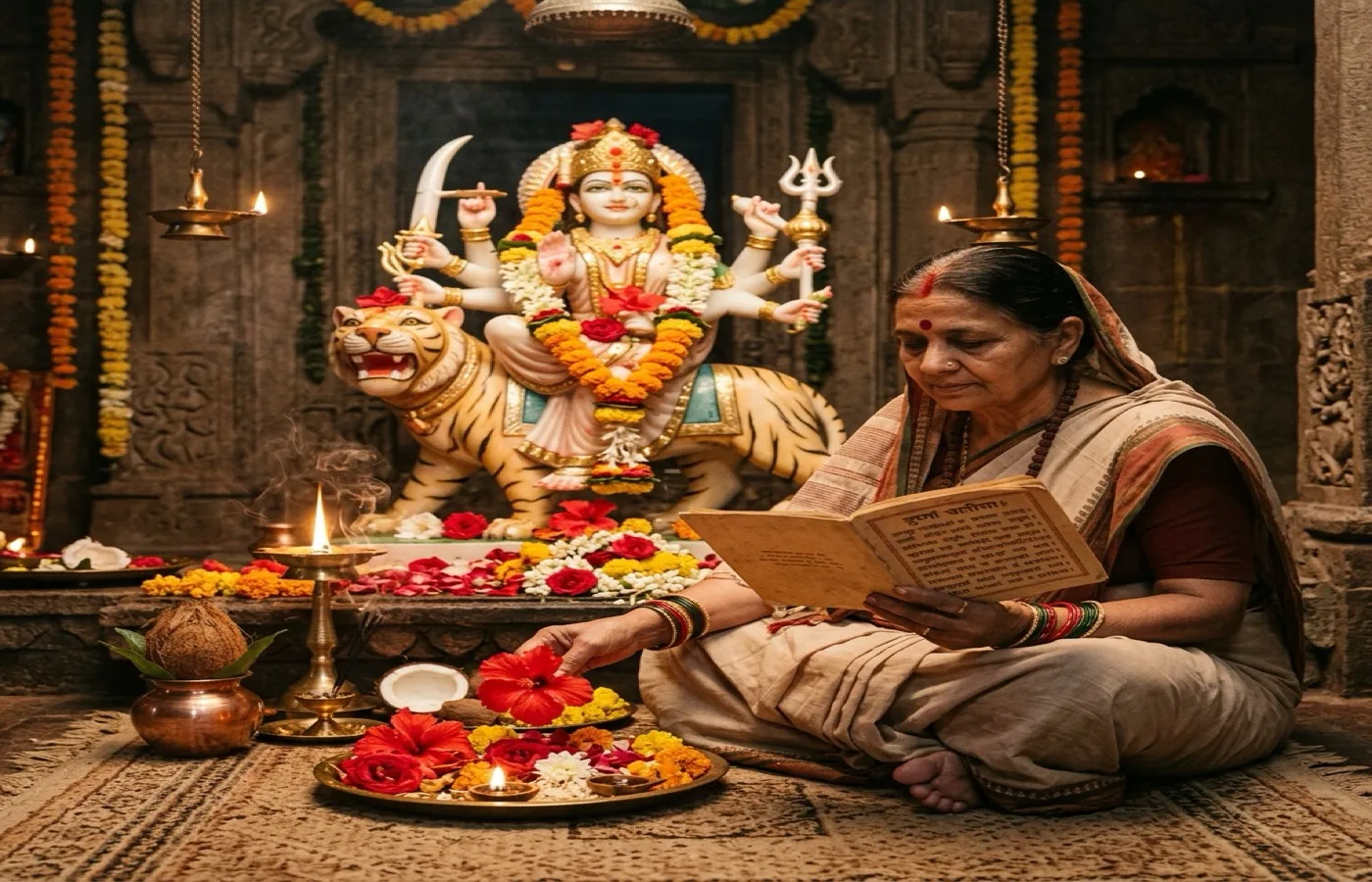
Goddess Durga represents protective Shakti, courage, and maternal grace, and this page connects her symbolism with daily worship and Navratri practice.
This page explains the common Jai Ambe Gauri Durga Aarti with full lyrics, simple meaning, recitation context, and a practical home worship sequence.
A practical guide to Durga mantra chanting, meaning, count, and home use for daily devotion and Navratri.
Navratri is a nine-night festival honoring Goddess Durga through prayer, fasting, discipline, home puja, and community celebration.
Durga Chalisa is a devotional hymn of forty verses in praise of Maa Durga. It is recited for courage, protection, and steady Shakti worship.
Durga Chalisa is commonly recited during daily home worship, Fridays, and especially during Navratri when Durga-focused devotion becomes more intense.
Yes. Beginners can start with the opening verses, read slowly, and build familiarity over time. A clean altar and sincere attention are enough.
Yes. Meaning helps the hymn move beyond memorization and become a real devotional practice with more focus and reflection.
Yes. Many devotees recite Durga Chalisa first and then sing Durga Aarti to close the worship session with light and gratitude.
A full recitation usually takes only a few minutes, depending on pace, pronunciation, and whether the devotee pauses for reflection.
The best way is to choose one fixed time, keep the routine small, and repeat it regularly rather than trying to do too much at once.