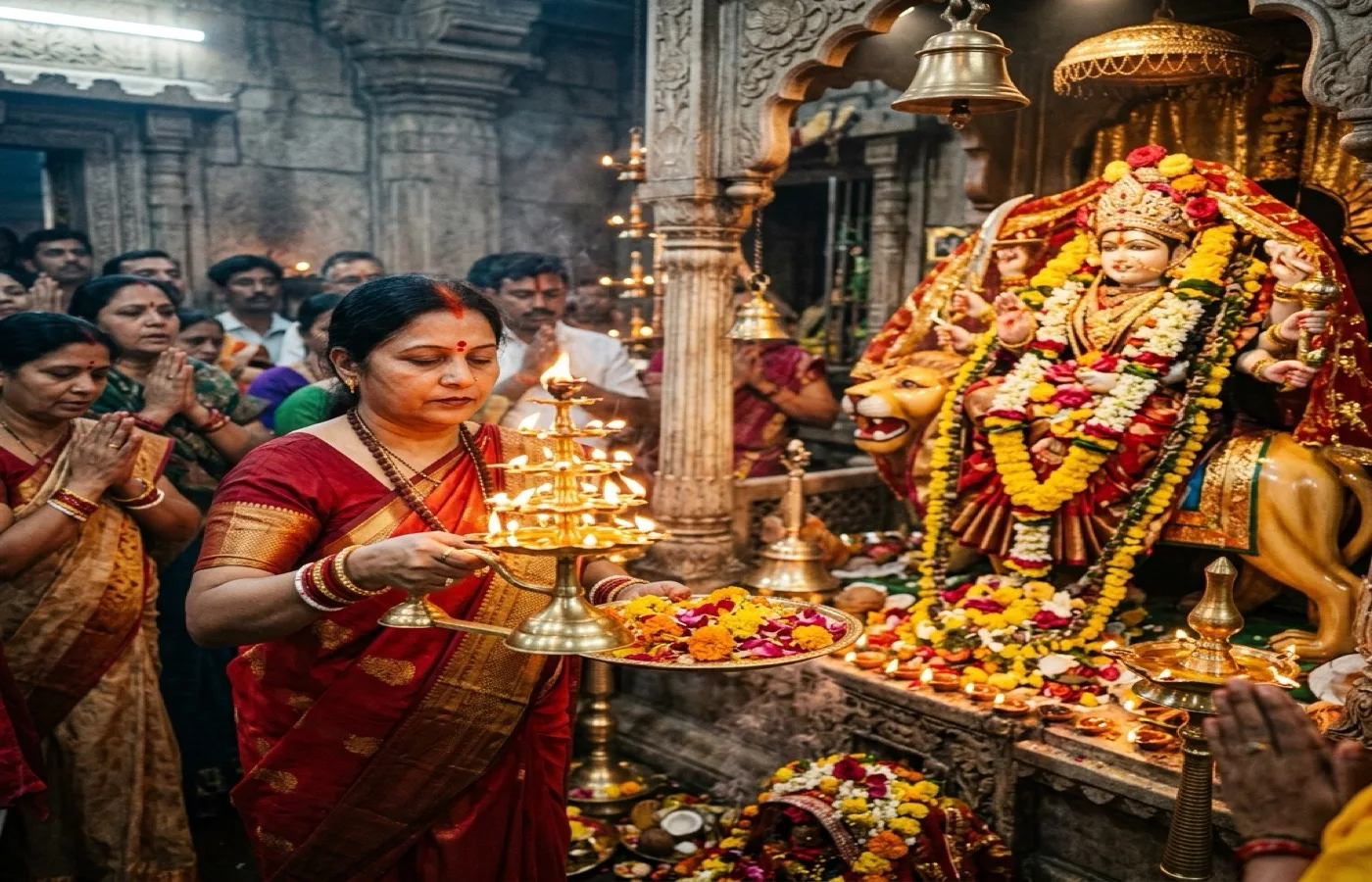
What Durga Aarti means in daily worship
Durga Aarti is not only a song of praise. It is the closing offering of light in which the devotee remembers Maa Durga as mother, protector, and destroyer of fear. In many homes the aarti comes after a brief puja, mantra japa, or reading from Goddess Durga. The flame, sound, and words together create a shift from routine activity into attentive prayer.
The best-known version is Jai Ambe Gauri. It praises Durga’s beauty, her radiant weapons, her lion vehicle, and her victory over destructive forces such as Mahishasura, Shumbh, and Nishumbh. That is why the aarti feels both gentle and powerful: it addresses the same Goddess as loving mother and fierce guardian.
A note on lyrics variations
If you compare printed booklets, temple leaflets, and family notebooks, you may notice small wording differences. This is normal with traditional devotional songs. A verse may be shortened, reordered, or pronounced differently from region to region. The common devotional center remains the same: praise of Maa Durga’s grace, strength, and protective presence.
For this page, the lyrics section presents the widely sung Jai Ambe Gauri version in a clean format for reading and recitation. If your family follows a slightly different wording, you can still use this page for meaning, home worship method, and Navratri context without conflict.
Meaning of the key images in Durga Aarti
Many devotees memorize the tune before understanding the symbolism. That is understandable, but the prayer becomes deeper when the main images are clear.
- Ambe and Gauri point to the divine mother who nourishes, guides, and protects her devotees.
- Sindoor, ornaments, and radiant face represent auspiciousness, beauty, and divine presence rather than material decoration alone.
- Lion vehicle symbolizes fearlessness, command over instinct, and courageous action in the face of difficulty.
- Sword and bowl remind the devotee that Durga removes negativity while also granting refuge and inner strength.
- Mahishasura, Shumbh, Nishumbh, Chand, and Mund are not only mythic opponents; they also represent pride, confusion, aggression, and tamasic inertia within the human mind.
- Aarti flame reflects the offering of one’s attention. When the lamp is raised before the deity, the deeper act is offering ego, fear, and restlessness into divine light.
Seen this way, Durga Aarti is not merely praise of a distant form. It is a disciplined reminder that devotion must produce courage, clarity, and moral steadiness in daily life.
Beginners often assume Durga worship requires a complex ritual setup. In reality, a simple and consistent format is far better than an elaborate routine that cannot be sustained. A practical home method looks like this:
- Clean the prayer space and place an image or murti of Maa Durga on the altar.
- Light a diya or camphor, and if available, offer flowers, kumkum, or simple prasad.
- Sit quietly for a few moments and steady the breath before beginning.
- Chant a short mantra such as “Om Dum Durgayei Namah” or read from Durga Mantra.
- Sing the aarti slowly enough that the words remain clear.
- Rotate the lamp in a respectful circular motion before the deity.
- End with folded hands, silent prayer, and one clear sankalp such as courage, discipline, or gratitude.
This sequence usually takes around five minutes, which makes it realistic for daily practice. The most important point is not musical perfection. Clear attention, humility, and continuity matter much more.
Why Durga Aarti is especially important during Navratri
Durga Aarti can be sung all year, but it becomes especially central during Navratri. During those nine nights, devotees increase prayer, fasting, japa, and reading connected to Shakti worship. The aarti then serves as a natural culmination of the day’s devotion.
In many households, the evening sequence during Navratri is:
- Light the lamp.
- Offer flowers or naivedya.
- Chant Durga mantra or Durga Chalisa.
- Sing Durga Aarti.
- Distribute prasad and sit for a minute of silence.
This matters because Navratri is not only festive devotion. It is also a period of purification and disciplined remembrance. The aarti gathers the emotional energy of the festival and directs it toward reverence rather than excitement alone.
How Durga Aarti supports spiritual discipline
Regular recitation helps in a way that is easy to underestimate. Aarti is short, repeatable, and emotionally engaging. That combination makes it ideal for building spiritual consistency.
When practiced daily or weekly, Durga Aarti can help the devotee:
- return attention to prayer after a distracted day,
- cultivate courage during stressful phases,
- remember sacred stories through repeated images,
- connect children and elders in a shared ritual,
- transition naturally from chanting into silent reflection.
These are practical gains, not just poetic ones. Devotional routines become powerful when they are small enough to sustain and meaningful enough to transform mood and conduct over time.
Common mistakes to avoid
The page should also help with what not to do. Most problems in aarti practice are simple.
- Do not rush the words only to finish quickly.
- Do not treat the aarti as background music while doing other tasks.
- Do not worry excessively about perfect singing if that anxiety breaks devotion.
- Do not assume a longer ritual is always a better ritual.
- Do not separate lyrics from meaning forever. Even a little understanding improves prayer.
If pronunciation is difficult at first, use the English transliteration slowly and return to the Hindi text regularly. Within a short time, familiarity improves naturally.
Best companions to this page
Durga Aarti is most helpful when used alongside a few connected practices rather than in isolation. A strong learning and worship path is:
These links are not filler. They answer the next real questions a devotee usually has: Who is Durga in theology and worship? What should I chant before the aarti? What should I do in Navratri? How can I move from one short song into a fuller devotional routine?
Durga Aarti for families and beginners
This page is especially suitable for family use because the practice can be divided naturally. One person can sing, another can hold the lamp, and another can explain one verse meaning to children. That keeps the ritual participatory without making it performative.
For beginners, a very manageable weekly approach is to focus on only three things for two weeks:
- learn the opening verse clearly,
- understand the symbolism of the lion and weapons,
- maintain one fixed prayer time.
After that, add more verses and deeper meaning. Devotion grows best when it is steady.
Final takeaway
Durga Aarti remains popular because it serves many needs at once. It is lyrical enough for temple and family singing, short enough for household routine, and rich enough to hold deep Shakti symbolism. If you use this page well, do not stop at memorizing the words. Let the imagery teach you courage, let the flame teach you attention, and let the repeated prayer create a more disciplined and fearless inner life.
 Devpur