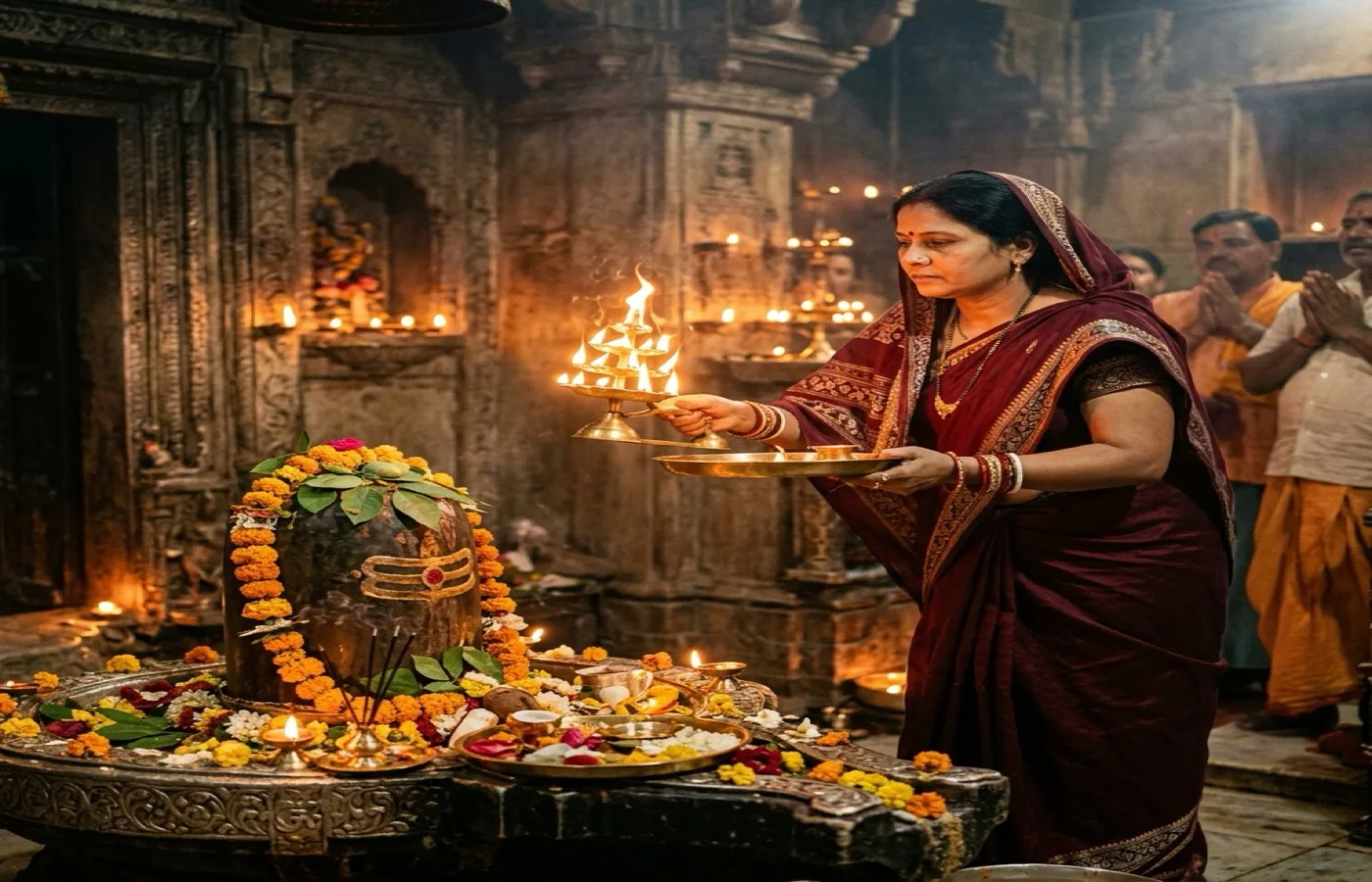
Shiv Aarti in daily worship
Shiv Aarti is one of the most practical forms of daily Shiva devotion. It is short enough to fit into a home routine and deep enough to carry the central ideas of Shaiva worship: stillness, surrender, creation, protection, and dissolution.
The common opening, Om Jai Shiv Omkara, points to Shiva as the sound and reality behind all forms. That is why this aarti often follows a mantra, a short puja, or a reading from Shiva.
Meaning of the main symbols
The aarti is rich with images that become more meaningful when read slowly.
- Brahma, Vishnu, and Sadashiv show Shiva as the source and support of cosmic function.
- Ardhangi Dhara points to balance, completeness, and union of power with awareness.
- Ekanan, Chaturanan, Panchanan refers to the many-faced form that symbolizes Shiva’s all-seeing presence.
- Vrishavahan reminds devotees of grounded strength and dharmic steadiness.
- Akshamala, banmala, and mundmala point to renunciation, time, and transcendence of ordinary fear.
- Kamandalu, chakra, and trishul reflect discipline, order, and the power to cut ignorance.
- Pranavakshar links Shiva with Om, the sacred sound behind all worship.
These images are not decorative. They help the devotee remember that Shiva is both stillness and power.
Full home practice
A simple Shiva worship sequence can look like this:
- Clean the altar and light a diya.
- Offer water, बेलपत्र, flowers, or simple prasad.
- Chant
Om Namah Shivaya a few times.
- Recite Shiv Aarti slowly and clearly.
- Ring a bell or circle the lamp with respect.
- Sit quietly for a brief moment after the aarti.
This routine is enough for daily use. A devotee does not need a long or complicated ritual for the prayer to feel complete.
Why the meaning matters
The words of Shiv Aarti become richer when the devotee pauses on each symbol. Shiva is not described here only as a deity seated far away. The aarti shows him as the divine presence behind creation, balance, and dissolution. That is why the hymn names Brahma, Vishnu, and Sadashiv together: it points to one reality appearing through different functions.
This also helps explain why the aarti is so widely used after a short puja. It gives closure, but it also gives perspective. The day can be busy and noisy, yet the aarti reminds the devotee that silence, order, and surrender are still available.
Why this aarti is important
Shiv Aarti works well because it brings theology into a short, repeatable hymn. Devotees who struggle to maintain long study can still return to this one prayer every day. Over time, the repeated words train the mind toward humility and steadiness.
It is especially valuable when paired with Mahamrityunjaya Mantra or Shiv Chalisa. The mantra sharpens attention, the chalisa gives longer reflection, and the aarti closes worship with gratitude and light.
Best time to recite
Many people recite Shiv Aarti:
- in the morning before starting the day,
- in the evening after work or household duties,
- on Mondays as part of Shiva worship,
- during Mahashivratri and other Shiva observances.
The exact time is less important than consistency. A short, steady routine usually produces more depth than an occasional elaborate performance.
Simple study path
If you want to make this prayer part of a stronger Shiva practice, keep a simple sequence for a few days: chant Om Namah Shivaya, read this aarti, and then sit for one minute in silence. After that, move to Shiv Chalisa or Mahamrityunjaya Mantra on another day.
That kind of rotation prevents fatigue and keeps devotion connected to understanding instead of repetition alone.
Common mistakes to avoid
A few simple mistakes can weaken the experience.
- Do not rush through the lines only to finish quickly.
- Do not treat the aarti as a background recording.
- Do not separate the sound from the meaning completely.
- Do not assume a longer ritual is always a better ritual.
- Do not let pronunciation anxiety break the practice.
If you need help with pronunciation, read the English transliteration first and then return to the Hindi lines after a few repetitions.
Family and beginner use
Shiv Aarti is especially useful for families because different people can take different roles. One can read, another can hold the diya, and another can explain the meaning to children.
For beginners, a good two-week starter plan is simple:
- learn the opening verse,
- understand the image of Om and the three divine functions,
- keep one fixed prayer time.
That approach is small enough to sustain and strong enough to become habit.
Final takeaway
Shiv Aarti is a compact but complete devotional form. It praises Shiva as the one behind creation, preservation, and dissolution, while also giving the devotee a practical way to return to prayer every day. If you read the lyrics slowly, understand the symbols, and keep the routine simple, the aarti becomes more than a song. It becomes a steady spiritual practice.
 Devpur