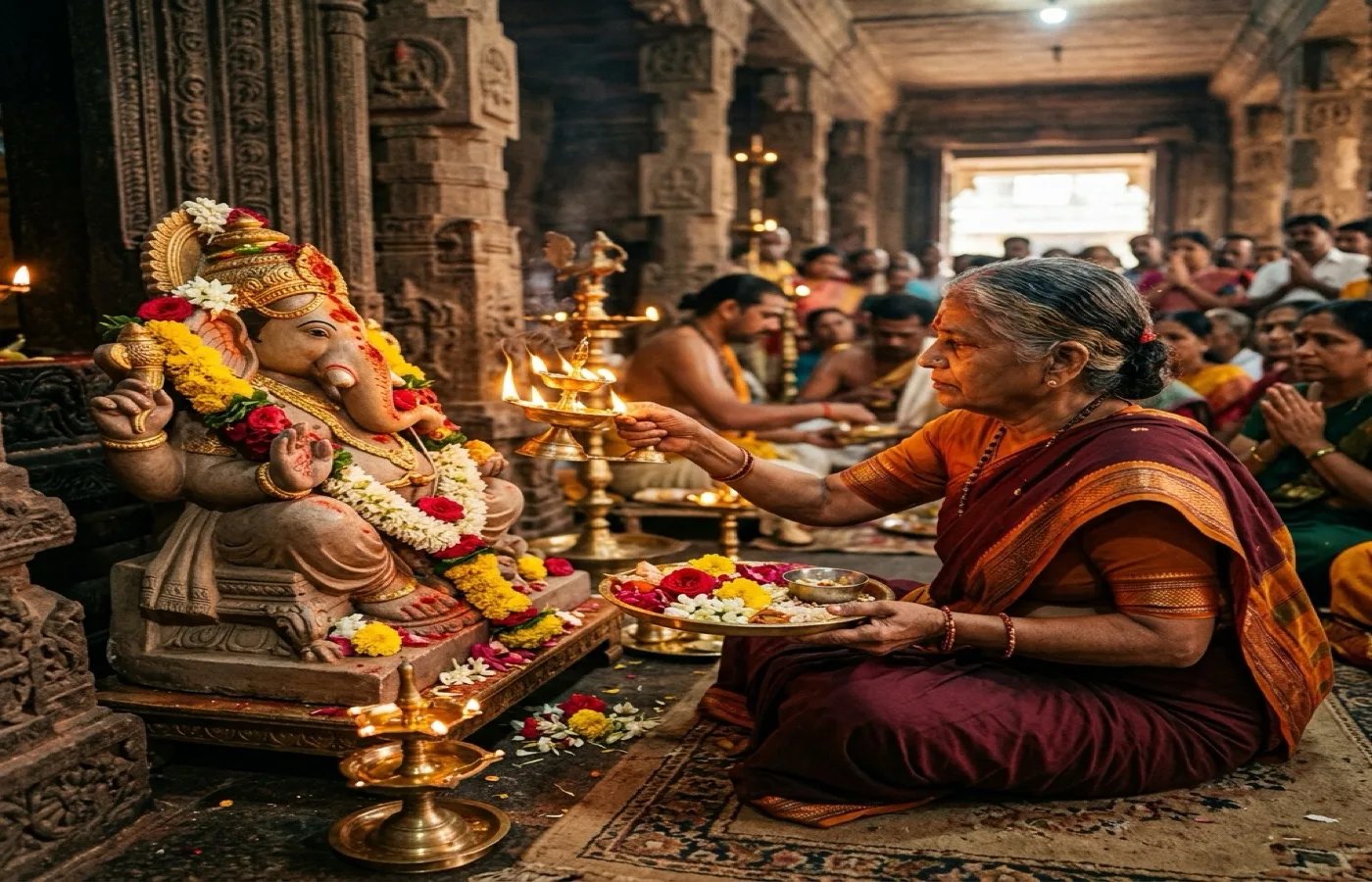
Ganesh Aarti and auspicious beginnings
Ganesh Aarti is one of the most familiar opening prayers in Hindu homes because it sets the tone for an orderly beginning. Lord Ganesh is remembered as the remover of obstacles, but the deeper meaning is broader: he represents wisdom that can organize desire, attention, and action.
The opening line, “Jai Ganesh Jai Ganesh Jai Ganesh Deva,” is a simple praise of the deity’s role in daily life. The image of the mouse and the steady posture of Ganesh together suggest that the mind must be guided, not suppressed. That is why this aarti is often sung before puja, study, work, travel, or an important household task.
What the main images mean
- Ekdant points to focus and unity of purpose.
- Parvati and Mahadeva remind the devotee that Ganesh belongs to the larger family of divine order and sacred wisdom.
- Mouse vehicle symbolizes a restless mind that must be trained.
- Modak represents the sweetness of fulfilled devotion and disciplined life.
- Siddhi and Buddhi show that true success needs both ability and clear judgment.
When these images are understood, the aarti becomes more than a song. It becomes a short lesson in how to begin the day with clarity.
The verse structure
The opening line is the most widely known, but the devotional effect comes from the sequence of ideas, not just the first couplet. The praise of Ganesh as Deva, the reminder of his parents, and the descriptions of siddhi and buddhi all work together to create a complete prayer for beginnings.
Rather than treating the aarti like a chant to rush through, read it as a layered meditation. The first layer is praise. The second is symbolic meaning. The third is personal application. This makes the page useful even if you already know the tune by heart.
A simple home worship routine
A good home routine does not need complexity. A clean place, a diya, and sincere attention are enough.
- Sit quietly before the image of Lord Ganesh.
- Offer a flower, a modak, or a simple sweet if available.
- Recite a short Ganesh mantra or begin directly with the aarti.
- Sing the aarti slowly and clearly.
- End with a prayer for wisdom, obstacle-removal, and disciplined action.
This sequence is easy to repeat daily and works especially well before study, office work, exams, or any new beginning.
How to use it before work or study
Many people keep Ganesh Aarti for special occasions only, but it is especially practical for ordinary days. Before a meeting, it can help settle nerves. Before study, it can reduce scattered attention. Before household responsibilities, it can create a sense of calm order.
If you only have one minute, read the opening line slowly and remember the meaning of the mouse and modak. If you have more time, pair the aarti with a short mantra and a brief silence afterward. That silence is often where the devotional effect becomes most visible.
How this page should be used
If you are using this page for study, do not stop at memorizing the words. Read the meaning of each image, then connect it to your own routine. For example, if work becomes scattered, remember the mouse and the need for direction. If a task feels heavy, remember that Ganesh worship begins with order and confidence rather than pressure.
Common mistakes to avoid
One mistake is to treat Ganesh Aarti as only a ceremonial opener and never reflect on its meaning. Another is to rush through the words without attention because the song feels familiar. A third mistake is to keep the ritual only for big events and ignore the daily value of small beginnings.
Ganesh worship works best when it becomes a pattern of clear starts. That means light, simple, and repeatable practice rather than occasional performance.
Related pages
This page connects naturally with Ganesh, Ganesh Mantra, Ganesh Chalisa, and Ganesh Chaturthi. Together they cover deity context, mantra, longer recitation, and festival observance.
Family use
Ganesh Aarti is ideal for family prayer because it is short, memorable, and positive. Children can learn the first line quickly, while adults can explain why Ganesh is associated with wisdom and clear beginnings. That makes the ritual both devotional and educational.
In family settings, it also works as a shared reset after a busy day. One person can light the lamp, another can place the offering, and children can repeat the opening line. This keeps the ritual simple enough to sustain and meaningful enough to remember.
Final takeaway
Ganesh Aarti is a compact but complete prayer for starting well. It brings together auspiciousness, wisdom, and discipline in a form that is easy to keep daily. If you use it sincerely, it can become your short reset before any important work or devotional practice.
If you want one devotional habit that is easy to maintain and easy to explain, this is one of the best starting points. It gives prayer a practical shape and gives routine a spiritual center.
 Devpur